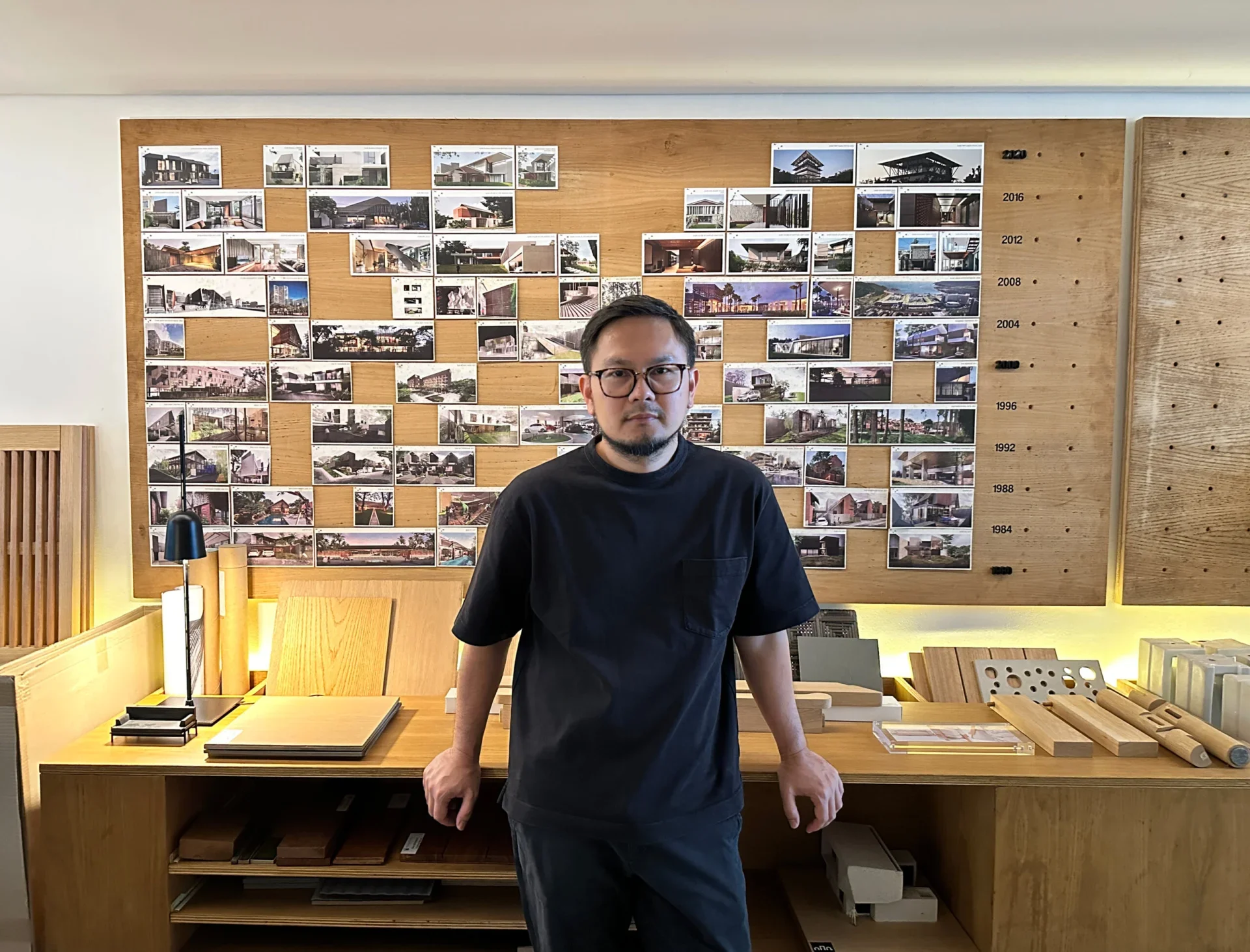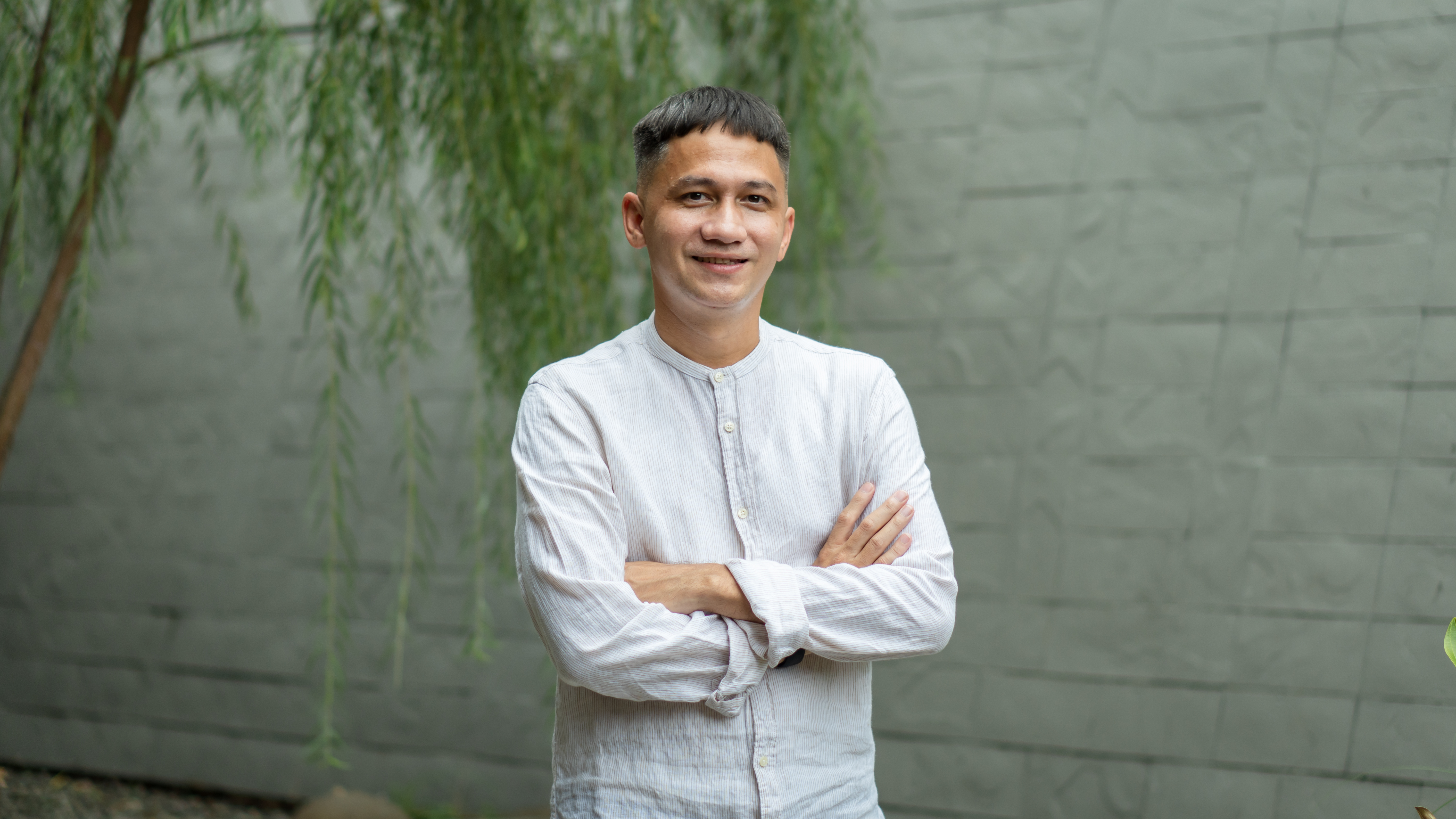
Raul Renanda sees design, architecture, and art as interconnected parts of his creative practice. Moving across disciplines and collaborations, he explores how logic and emotion can shape the making of a work.
Talking about a profession, we may be used to placing someone under a single label: architect, designer, or artist. But what happens when one name exists across several fields at once, with the same level of seriousness and professionalism in each?
Every creative process has its own rhythm. For Raul Renanda, there is a fairly clear line between how the mind and emotions work in bringing a work to life, but the two always take on different proportions in his process. Fine art is largely born from feeling, while design relies more heavily on thought.
Living as a multidimensional creator, Raul is also open about sharing his experience as an individual on the autism spectrum, specifically ASD Level 1, commonly associated with Asperger’s. He sees his brain wiring not as a limitation, but as a different way of seeing the world—one where honesty and depth have become integral to his creative process.
As a multidisciplinary designer, Raul moves fluidly between the technical precision of architecture, the exploration of product design, and the emotional freedom of abstract painting. This diversity can be seen across the various cross-disciplinary projects he has worked on: designing the SR1928 grand piano with musician Aksan Sjuman, developing the structure of the SKR40 yacht in Turkey with naval architect Nino Krisnan, and, most recently this year, shaping the visual identity of the luxury train The Nusantara Express together with the KAI team and Abel Hesed from Batik Wolter.
His exploration also extends into a more spontaneous art practice, such as a three-month live painting session in the lobby of The Apurva Kempinski Nusa Dua, where the public could witness his creative process firsthand. The message behind the project was to show that creating a work does not require complicated techniques; it is simply about following how he can be honest and pour his feelings into a painting.
For Raul, this diversity is not about collecting professional labels, but rather part of an exploration that flows naturally through his life and creative practice.
Read Written’s conversation with Raul Renanda below.
Practical Realities: Shaping a Cross-Disciplinary Routine
Written: Looking at your portfolio, which spans architecture, interiors, product design, and fine art, your schedule must be incredibly dynamic. How do you divide your time between these different roles?
Raul Renanda (RR): For me, it actually feels quite natural. Perhaps from an outsider’s perspective, because people are used to seeing specialists in their respective fields, it may look like I’m constantly jumping around. But that’s not really how it feels to me. In a single morning, before lunch, I can move from one project to another, much like someone handling a regular architecture project.
Biologically, I was born with this kind of brain wiring. In the morning, my left brain is more active, so it works well for technical things such as checking working drawings, creating detailed detailing, or handling financial matters. At night, once the evening routine has settled in, my brain finds it much easier to come up with new ideas.
Written: In the professional industry, there is often advice to specialize in just one field. Was choosing to work across multiple disciplines part of your original plan, or did it develop naturally?
RR: It came naturally. There is actually a term for this phenomenon: The Da Vinci Man. There are many people like this, but dealing with the stigma from outsiders can be incredibly difficult, so many choose to keep it hidden. I experienced the impact of that myself.
There were even clients who once told me, “I used to be afraid to meet Mas Raul.” But over time, society and younger clients have become more broad-minded. They see my experience across different fields as something that can actually help their projects through a 360-degree design approach.
Written: When faced with clients’ doubts because your focus is divided across multiple disciplines, how do you convince them through the final result?
RR: In the end, people filter themselves. There has to be an initial step where they get to know me and understand what’s in my head. I always emphasize the importance of collaboration. I never work alone. When I designed the piano, there was Aksan Sjuman, who understands acoustics. When I designed the yacht, there was Nino Krisnan as the Naval Architect. I never work alone. As long as we are honest and communicate directly, we will find the people who are the right fit.
Art for Feeling, Design for Thinking: Between Canvas and Logic
Written: In architecture, you have to compromise with your client’s needs, while in painting, you are completely free. How do you see these two conditions?
RR: In my case, painting is the balancing of everything. The easiest way to distinguish design from art is this: design is thinking—which is why we have the term design thinking—while art is feeling. My paintings are very intense because I pour the emotional energy of my life into them.
However, in the art world, 90% of the process is actually very technical hard work, from finding a studio and training the craftsmen to testing materials. The actual act of the artist itself is very small: it happens in the moment when my fingers and emotions leave paint across the canvas.
Written: People often look at an abstract painting and say, “I could do that too.” How do you respond to that kind of perspective?
RR: The easiest analogy is this: a healthy man can certainly lift a five-kilo weight if you ask him to. But does that automatically make him a bodybuilder? The difference lies in consistency and focus—doing it over and over again. I deliberately make my painting technique as simple as possible so there is no barrier between my feelings and the strokes on the canvas.
The moment my design logic comes in and tries to organize the painting so that it looks balanced, the painting actually becomes worse and loses its feeling. Everyone can say the words “I love you,” but it is the meaning, sincerity, and context behind those words that give them value.
Written: When designing complex products such as the SR1928 grand piano or SKR Yachts, how much does your architectural background help with the execution?
RR: A great deal. On the SR1928 piano, the legs are designed at an angle, even though the piano weighs up to one ton. To achieve a stable angle, I applied structural principles from architecture. The same thing happened when designing the yacht in Turkey, where there was an upper glass section designed as an overhang.
The ship contractor initially said it could not be done because dynamic loads at sea are different from those of a building on land. But our team tried to solve the problem using building-structure logic, adding reinforcement, and when it was tested, it turned out to be rigid.
The Synergy of Creativity, Collaboration, and Mental Resilience
Written: One of your latest projects is the design of The Nusantara Express train. Could you tell us about the concept and creative process behind it?
RR: This project came in at the last minute during holiday, even though we had actually talked about it for a long time before. For some reason, the timing was never quite right to discuss it further, and then, out of the blue, I came across the project again in early 2026. The creative approach I used was similar to how I handle other major projects with tight deadlines. I approached it like one of chef Jamie Oliver’s old shows: open the fridge, see what ingredients are available, and start cooking from there.
I collaborated with Abel Hesed from Batik Wolter as my main partner. We redesigned nearly 30 Nusantara craft patterns—not just batik, but also incorporating elements of ulos, songket, Toraja, and Sumba. At the time, I also happened to be hiding in Bali, so I had the time to focus on finding inspiration.
There was also an implied message behind this project: that Indonesia’s journey is rich with cultural intersections. The dedication and support from the Kereta Api Indonesia team throughout the project were highly professional, and I was incredibly supported by them.
Written: Looking back at your career journey, what practical advice would you give young designers with many interests so they do not lose their way?
RR: First, be true to yourself, which means being honest with yourself. In design school, we are constantly trained to seek validation from other people or from the market so that we can make a living. But we have to be brave enough to look at ourselves in the mirror from a 360-degree perspective and accept all our strengths and weaknesses.
People can tell when we are pretending, or faking it, and if we are not real, we will never be able to reach our full potential. Second is being mentally resilient, or having mental toughness. Finally, start every project with good intentions. Those good intentions will become our mental shield when we face problems.
Written: If Raul Renanda were defined as a food, what food would best represent you? And why?
RR: Lately, I’ve only just started feeling comfortable talking about my brain wiring. I was diagnosed with ASD Level 1, or what is popularly known as Asperger’s (high-functioning autism). The way I see the world is indeed different from other people. If you ask what I look like from the outside, perhaps the best answer would be to ask the people who see me and can judge me.
But if I had to be represented by a dish, perhaps the answer would be gado-gado. The ingredients are all different, but once mixed together, they become one dish that can be enjoyed by many people. So, please try to see me as one whole thing that can be useful to others.